Saturday, January 29, 2011

What Yeats Said

From Mac Dewart: Yeats said, "We never know when life will catch fire and become art."

Here's a thought: We labor as sculptors not knowing really whether it's Art with a capital A or not.... but we pour our life force into the process none-the-less, we exhaust ourselves mounting shows, we scrounge and borrow and go broke at the last minute, hoping for that moment of fire when the work comes alive and we can't take our eyes off it. In my own work, I never know for sure, but.... in Your Work all of you.....I find inspiration. Three examples: walking into Charles Jones' show, I had to shout out loud, so dazzlingly strong and authoritative the drawing and sculpture was. Looking carefully at Rosalyn Driscoll's piece The Nothingness of Fire, it seemed a tour de force, like nothing I'd ever seen, yet also like everything...flesh, mountain, river...the light at the heart of the world. And at the Scoop show one night, there was a cluster of onlookers around David Lang's piece in the window absolutely mystified, shouting their amazement "at the pigs that could fly." Thank you all for your moments of fire.

Eric Sealine responds: I remember seeing a show at the Art Institute in Chicago in about 1975. I had driven six hours from Ames, Iowa, and saw a substantial collection of genuinely contemporary art for essentially the first time. There was a Christopher Wilmarth sculpture on the wall, about 3' square, of slumped glass, maybe 3/8" thick, with the center square frosted and the rest clear. It was hung from the wall with a single wire that passed down one side on front, around the back, and back up the other side of the front. The shadow was an integral part of the object. It was the most beautiful and elegant and simple thing I had ever seen, and at that moment it occurred to me that this was something you could make your life about. I walked into the museum as one of those young vaguely artsy types, and I walked out as an artist. You never know.

What's YOUR experience? Let us know -

Laura Evans and Jessica Straus in Trigger and Reconfigure

Trigger and Reconfigure
Jan. 22 - Feb. 21, 2011
Jewitt Gallery at Wellesley College

This exhibition explores how an artwork begins with an encounter between an object or image and the artist. The found form, not necessarily interesting or beautiful to others, is so compelling to the artist that it must be engaged with, seized even. Intuitively the artist understands the possibilities this form offers for reinvention. And thus the art-making process begins. There will be dialogue surely, sometimes a grappling, a coaxing or a nudging of this form until new light or a new life emerges.

Tuesday, December 21, 2010

Featured Artist: Eric Sealine


What intrigues me most about artists is not necessarily what they are working on but where they came from and where they have been. Just by learning about someone’s past you gain a greater appreciation for what they create now and who they are. Their background influences every piece of art they make, paint, or build, whether they know it or not.


When I spoke with Eric Sealine, this same fact proved to be true as well. Sealine’s current and future work is based on his past experiences. Sealine has a show scheduled for 2012 at the Boston Sculptors Gallery. The theme for his show, unless things change, will be based on the creek that he played in when he was a kid in Delaware.


Through perspective, Sealine wants to show the natural history of the creek he so often visited as a child. He is very interested in the idea of perception and how it works. People are easily fooled, why is that? People also love to be fooled. However, he does not want the show to be a story of loss but instead that of a gift he experienced as a child. He is also trying to incorporate how our memories get smoothed and changed by taking them out and toying with them as we get older. The concept is one that anyone can relate to.


Sealine’s past has influenced his work in numerous ways. For example, he has built boats by hand and still has the first boat he ever built, which he sails to this day. He was also an architectural model maker. His carpentry skills translate directly to his current works in progress, as well as his studio, which he built.


A lot of Sealine’s work has a three dimensional illusion to it. The picture above is a good example of a three dimensional illusion. It has no official title yet but is just being called, A Work in Progress. Sealine’s work is fun and carefree and when I see this picture, well, I enjoy being fooled. Submitted by Jen Costa, Boston Sculptors Gallery intern.

Featured Artist: Rosalyn Driscoll


Which material should you choose to work with for your next sculpture? Wood, Metal, plaster? How about rawhide? I bet you haven’t worked with this particular material yet! Rawhide is Rosalyn Driscoll’s medium of choice in her most recent show at the Boston Sculptors Gallery, Natural Light.


Driscoll first came across rawhide while she was in New Mexico for an artists’ residency. She was in a drum store and saw a painting on rawhide. After some conversing with people at the store and figuring out that it could be shipped to her, it was an obvious choice for Driscoll that she wanted to work with this material. Driscoll’s father used to own ranch land so her current pieces connect her to her past. Driscoll also is drawn to the rawhides ability to hold form, translucence, and irregularities.

So what draws Driscoll to create art with this material is the fact that the rawhide allows her to make forms that are organic. Driscoll was looking for a way to enliven and mobilize rectilinear forms that she was working with, so what better material to use than a form of skin. Her work is also about containment as well as being rectilinear and how skin is the ultimate container. Driscoll also added some neon lights in her rawhide pieces to amplify the feel of energy in certain pieces. She also used the lights because she was attracted to the transparency of rawhide.

In her piece shown here, Revelation, Driscoll was trying to show that things encounter our quiet, orderly world unexpectedly, for example when someone dies suddenly, or a job changes. The rawhide resembles a hand is passing through this square box that is lined with copper leaf.

As for Driscoll’s future direction, she says she will continue to explore working with rawhide to take it to its next phase. In the spring she will be working in London with some other artists who will be putting together a show on touch and other sensory forms of art. Lastly, she is also collaborating with a neuroscientist. Submitted by Jen Costa, Boston Sculptors Gallery intern

Monday, November 22, 2010

Featured Artist: Andy Zimmermann


When I think of sculpture, I think of a stationary object that was produced by human hands that I can sit and look at while it is on display. However, the other day, I was introduced to a piece of art done by Andy Zimmerman which was a mixture of sound, video, and sculpture all in one.

Zimmerman finished graduate school at Mass School of Art in 2003. After school he then started using video and sound in his artistic process. Prior to graduate school, Zimmerman’s art work was mostly sculpture with some painting early on in his life. Now Zimmerman is interested in how to integrate video and sound into his new works.

Zimmerman has designed computer programs that sound like instrumental music but are actually computer generated sound. These programs when finished look like a spider web of some type of complex math problem. They appear very intimidating and daunting; however, Zimmerman enjoys making them for his works. He then turns that unique sound back into sculpture. Zimmerman has also used video projection in his installations. In some ways, he feels like he is incorporating painting with the video projection because it is able to manipulate objects. For one installation, Zimmerman used old car parts as his projection surface. The parts were all painted white and then very specific masks were generated on the computer to project exactly what Zimmerman wanted to show.

Zimmerman also likes to use frosted Plexiglas in his work. He enjoys the visual effect that the Plexiglas gives off. For example, in Either Nor, Zimmerman constructed the frame and glass in an abstract geometric way. He then included the image that would serve as a human body in the piece. The theme of the piece was about being haunted and how things of this nature are not very clear but instead give off a foggy presence.

I was able to get a sneak peek at Zimmerman’s most recent work in progress which will be at the BSG in the spring, but I am sworn to secrecy and can’t give you any hints, so you will have to wait and see! Andy Zimmermann’s work will be on view at Boston Sculptors Gallery April 20 - May 22, 2011. Submitted by Jen Costa, Boston Sculptors Gallery intern.

Featured Artist: Joseph Wheelwright


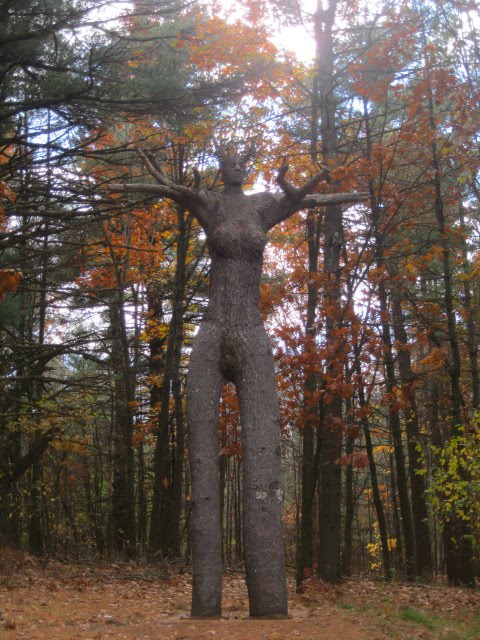
I happened to luck out today. I was able to interview Joe Wheelwright, and during our interview, Wheelwright told me of his Tree Figures show at the Fruitlands Museum in Harvard, MA, and mentioned that sadly, it would be coming down in two days. I thought to myself, “well maybe I’ll see it before he takes it down.” However, I had a very busy weekend and didn't think I would make it. But due to pure luck, I did get the chance to see Tree Figures. I ended up bringing my husband with me to see Wheelwright’s show the day before it was coming down.


I have never been to the Fruitlands Museum grounds, so it was quite a sight. The museum is set on higher ground so you are able to look out and see a scenic vista. It was beautiful, especially with the fall foliage, even though it’s fairly late in the season. I must say that I have never seen quite a show like this one.


We were given a map when we bought our tickets and had to walk through fields and forest to see the Tree Figures. As we began our walk, it was clear that Wheelwright’s Tree Figures, eight trees and one stone carving, were very thoughtfully placed throughout walking trails. Each tree seemed to fit naturally into it’s surrounding area. It was almost as if they were meant to be there all along. As we walked through the exhibit, we came upon tree after tree. We even became a little lost at one point turning this “show” into a small adventure. Walking along the path, we came into a clearing and that is when we saw it, The Oracle, one of Wheelwright’s main trees. It was standing tall and omniscient at the end of the clearing. This tree gave off a feeling of power as we stood there gazing at it. It was beautiful but at the same time, intimidating because it seemed like it was naturally grown there. We both joked and said that if we didn’t know that this was an art show that we would both have probably run in the opposite direction of The Oracle!


I only wished that I knew of this show earlier. However, the trees are now on the move. Wheelwright will be showing some old and some new works in New York next year. So if you want to experience an artistic adventure go see the trees, I promise you will not be disappointed! Joe will also be exhibiting his works at the Boston Sculptors Gallery at 486 Harrison Avenue from January 5 - February 6, 2011. Meet the artist at one of the First Friday receptions Jan. 7 and Feb. 4 from 5 - 8 pm, or at the artist reception Sat. Jan. 8 from 3 - 6 pm. Submitted by Jen Costa, Boston Sculptors Gallery intern.

Featured Artist: Sally Fine


Sally Fine’s latest show at the Boston Sculptors Gallery will instantly give you the intense desire to travel. Her brightly colored ceramic figures are reminiscent of folk art from island communities. If you have ever been to an island outside of the United States, either on a cruise or vacation, then you know what I mean. As Fine walked me through her show, I couldn’t help but desire to go on vacation to see more of this art. While in the Dominican Republic, Fine explained that everyday at 4:00 pm, these girls from a nearby school would come outside and they would be wearing these rich colors, and had such rich skin. Fine was entranced by these colors and decided to use them in her work.

Fine also incorporated boats and fish hooks into some of her work. Boats are seen in the Dominican Republic as an escape while we in the United States see them as a means of travel, or vacation.

Fine has traveled, in the past three years, to places such as La Romana, in the Dominican Republic, Spanish Wells in the Bahamas, and Vallauris, France. These experiences outside the country have greatly influenced her current work. Fine has even incorporated hair from one of her students in La Romana into one of her ceramic pieces. However, all of this traveling necessitated that Fine adapt to her environment. For example, in La Romana, Fine had to work with minimal studio equipment which caused her work to become smaller in scale where her prior works were much larger in scale. In Vallauris, Fine spoke enough French to get by but could not communicate with others, so she found a book shop that sold English language books, which were hard to find, and went there frequently. This bookstore and books greatly influenced Fine’s piece, Coordinates: SE, E, and SW.

As for Fine’s future work, she says she will continue to use fishing wire and most likely will get larger in scale, but she will be done with ceramics for the time being. We’ll have to wait and see what art comes from her future travel plans. Fine’s work is on view at Boston Sculptors Gallery through December 12. Submitted by Jen Costa, Boston Sculptors Gallery intern.